The 2026 Dodge Charger Sixpack Is Actually Good. We’re Shocked.
After the divisive Daytona EV, Dodge’s new twin-turbo inline-six proves that redemption sometimes comes with a tailpipe.
There’s something almost vindictive about the way Dodge introduced the Charger Sixpack. After spending the last year defending the Daytona EV—genuinely trying to make peace with its contradictions and compromises—here comes the gas-powered alternative, essentially saying “Yeah, we heard you. Here’s what you actually wanted.” It’s a bit like watching someone apologize by building exactly what they should have built in the first place.
But here’s the thing: it worked. The 2026 Dodge Charger Scat Pack Sixpack isn’t just better than the Daytona EV in obvious ways. It’s genuinely, measurably different in character, purpose, and how it makes you feel behind the wheel. And despite that $56,990 price tag, there’s a legitimate argument that it’s the performance bargain of the year—assuming you’re okay with a 206-inch-long, 4,800-pound piece of automotive machinery that drives like an AMG S63 with attitude issues.
2026 Dodge Charger Scat Pack Sixpack (12)
2026 Dodge Charger Scat Pack Sixpack (11)
20-2026-dodge-charger-sixpack-scat-pack
2026 Dodge Charger Scat Pack Sixpack (10)
2026 Dodge Charger Scat Pack Sixpack (9)
2026 Dodge Charger Scat Pack Sixpack (8)
2026 Dodge Charger Scat Pack Sixpack (7)
2026 Dodge Charger Scat Pack Sixpack (6)
2026 Dodge Charger Scat Pack Sixpack (5)
2026 Dodge Charger Scat Pack Sixpack (4)
2026 Dodge Charger Scat Pack Sixpack (3)
2026 Dodge Charger Scat Pack Sixpack (2)
2026 Dodge Charger Scat Pack Sixpack (1)
2026 Dodge Charger Scat Pack Sixpack (13)
The Twin-Turbo Hurricane That Wouldn’t Quit
The heart of this redemption arc is the 3.0-liter twin-turbo inline-six Dodge calls the Sixpack. In Scat Pack form, it produces 550 horsepower and 531 pound-feet of torque—numbers that immediately command respect in a car that weighs nearly two and a half tons.
What’s genuinely interesting about this engine is how Dodge engineered it. Rather than wringing every last revolution from a screaming motor, engineers deliberately set the redline at just 6,000 rpm. Initially, this seems conservative to the point of silly. A six-cylinder should sing, right? But Dodge’s logic is sound: they extracted everything they wanted from this displacement at this boost level with this redline. Raising it would require different valve timing, different cam profiles, different cooling architecture—all for marginal power gains. They could do it for a future model, but why? The current strategy works brilliantly.
The engine pairs with an eight-speed automatic transmission—competent, if not thrilling—and feeds power through a wet-clutch transfer case to all four wheels. This all-wheel-drive setup isn’t some accommodation to winter weather. It’s a performance necessity. The rear wheels physically cannot put 550 horses on the pavement without tire smoke—unless you’re actively trying to do burnouts, in which case they absolutely can.
The reason becomes obvious the moment boost engages. Below 2,300 rpm, it’s lag city—nothing to write home about. But once those turbochargers spike (especially if you downshift to force them), all 30 psi hit like someone just stepped on your spine. The surge is confident, aggressive, purposeful. This isn’t the linear power delivery of a naturally aspirated V-8. This is turbo drama, and it completely changes the driving character.
2026 Dodge Charger Scat Pack Sixpack
Launch Control Theater
Getting all that power to the ground requires some ceremony. The launch control system—buried several menus deep in the infotainment screen—eventually works as intended once you navigate the labyrinth. It’s mildly irritating until you have it displayed, then it’s easy to use at the tree. Multiple dragstrip passes during our test revealed the car is remarkably consistent, varying by only fractions of a second run-to-run. That’s genuinely impressive engineering.
The line lock feature, however, demands a degree of coordination that feels like a bad joke. Stand on the brake, press and hold the OK button on the steering wheel, release the brake but maintain button pressure, then floor the throttle while still holding. Release the button and you’re rolling out. Release it prematurely and the whole thing cancels. Pat your head, rub your belly, recite the alphabet backwards, and maybe you’ll get a decent burnout. It’s obtuse beyond reason.
Off the line, the Sixpack delivers impressive urgency. From a roll, the 4,800-pound mass makes itself known—this isn’t a lightweight, and it doesn’t pretend to be. The transmission generally handles downshifts intelligently, but you can catch it out of sync exiting tight corners even in Sport mode. The paddle shifters (which are frustratingly tiny, by the way) fix this issue, and—refreshingly—they offer true manual mode that won’t auto-upshift at redline. You can consistently feel 6,000 rpm arriving in the lower gears, which demands attention but prevents careless mistakes.
The All-Wheel-Drive Advantage
This is where the Sixpack separates itself from what a pure muscle car should do. The power split defaults to 50 percent front, 50 percent rear. In Sport mode, it shifts to 40/60, favoring the rear. Select Sport and you can toggle to rear-wheel drive entirely.
But here’s the critical insight: don’t actually use rear-wheel drive for driving. Yes, it’s fantastic for burnouts and controlled drifts. But for actual road driving? The car can’t handle it. With stability control enabled, moderate throttle input while turning invites computer intervention. With it disabled, you’re immediately sideways. The physics don’t work. Dodge engineers know this—they’re explicit about why standard AWD exists: performance, not just winter capability.
The all-wheel-drive setup fundamentally transforms how this massive car behaves. It doesn’t drive like an all-wheel-drive car in the sense that you’d recognize from Audi or Subaru. The nose doesn’t pull you out of corners. Instead, the system tames the rear during aggressive throttle application, spreading power across twice the rubber. It’s the difference between spectacular crash and controlled acceleration.
Stay in AWD, and the steering transmits slightly more feedback than you’d otherwise get. It’s a dash of additional information—not transformative, but appreciated. The trade-off is sacrificing outright steering feel for mechanical traction. Given the alternative is a hyperactive rear axle, it’s an acceptable compromise.
There’s one genuinely annoying limitation: rear-wheel drive can only be activated at a complete stop, even though you can switch back to AWD while moving. Dodge acknowledges this could change with future software updates, but right now it’s an arbitrary restriction that doesn’t make sense.
2026 Dodge Charger Scat Pack Sixpack (11)
The Steering Question
The steering itself sits in an uncomfortable middle ground. It’s numb compared to what enthusiasts want, responsive compared to what casual drivers need. It’s on the slower side, requiring more steering input in tight corners than feels natural and demanding quick hands if you’re attempting controlled drifts. The active noise cancellation in loud exhaust mode somewhat compensates by making the engine note more theatrical, but the steering is what it is: functional, competent, uninspiring.
Infotainment Frustration
Accessing all these performance modes requires diving into the infotainment screen, which is laggy and excessively layered with menus. Rear-wheel drive selection is locked to Sport mode. Steering weight adjustment requires Custom mode. The dual-mode exhaust is tied to engine calibration—either calm or aggressive, no mixing and matching. You cannot fully customize the driving experience the way modern enthusiasts expect.
Dodge engineers are aware of these frustrations. Yes, future over-the-air software updates may address them. Yes, this is probably cold comfort if you’re staring at these limitations today.
The good news: the car wasn’t buggy like earlier vehicles we’ve tested. Nearly all software glitches appear fixed. There was one random incident where the driver’s seat lumbar support adjusted itself to maximum during driving, but Dodge has already corrected that on more recently built cars. It’s the kind of detail that matters.
2026 Dodge Charger Scat Pack Sixpack
That Exhaust Situation
The dual-mode exhaust system won’t satisfy V-8 purists. The startup rumble is respectable—reminiscent of BMW M-series cars—but loses character once you’re moving. It sounds like, well, a turbocharged inline-six. Dodge added some chainsaw snarl in loud mode, which sounds more impressive from inside the cabin (where active noise cancellation enhances it) than from outside.
We tested this at a stop sign where some Mustang enthusiasts asked for a rev. Their lack of enthusiasm said everything.
Compared to the old SRT and Hellcat Hemi models, this Scat Pack is almost quaint. A Mopar Direct Connection cat-back exhaust will arrive eventually at roughly $4,000. Dodge should make it standard on the Scat Pack, frankly. Hopefully it doesn’t drone like the stock exhaust on the highway.
The Bigger Picture: Engineering Compromise Done Right
What’s remarkable about the Charger platform is that Dodge designed it to accommodate a battery pack and a gas engine with roughly equal engineering elegance. Rather than shoehorn one powertrain into a platform designed for another, they built flexibility into the architecture itself. This is the kind of multi-powertrain engineering compromise that should invite skepticism, but Dodge somehow executed it without obvious sacrifice to either variant.
The EV still handles better. The gas engine is still quick. They inhabit different philosophical spaces while sharing the same basic structure.
Performance and Real-World Numbers
Dodge’s claimed 0-60 time is 3.9 seconds with the quarter-mile at 12.2 seconds. Our eighth-mile dragstrip passes suggested the car is capable of those numbers—consistency across multiple runs indicates solid engineering in the launch and power delivery systems.
The curb weight of 4,800 pounds means the weight-to-power ratio lands at 8.7 pounds per horsepower. Compare this to the incoming R/T model with 420 hp and 468 lb-ft: that version will push 11.4 pounds per horsepower. Dodge hasn’t confirmed plans, but those numbers suggest the R/T variant might become redundant, following the same path as the EV Daytona R/T before it.
EPA range is estimated at 368 miles on a tank. Fuel economy figures haven’t been officially tested yet, but expect reasonable efficiency for a turbocharged performance sedan of this size.
Pricing Reality Check
$56,990 to start is genuinely expensive. But that’s what muscle cars cost now. A Mustang GT with performance package and automatic transmission costs identical money while being four-tenths slower to 60 and through the quarter. Add that $4,000 cat-back exhaust to the Charger and it still costs $5,000 less than a Mustang Dark Horse while producing more power.
The value proposition becomes complicated when you factor in the R/T variant arriving next year at $5,000 less while surrendering 130 hp and 63 lb-ft. That weight-to-power penalty is significant. Unless you specifically need the base price positioning, the Scat Pack justifies its premium.
Design and Dimensions
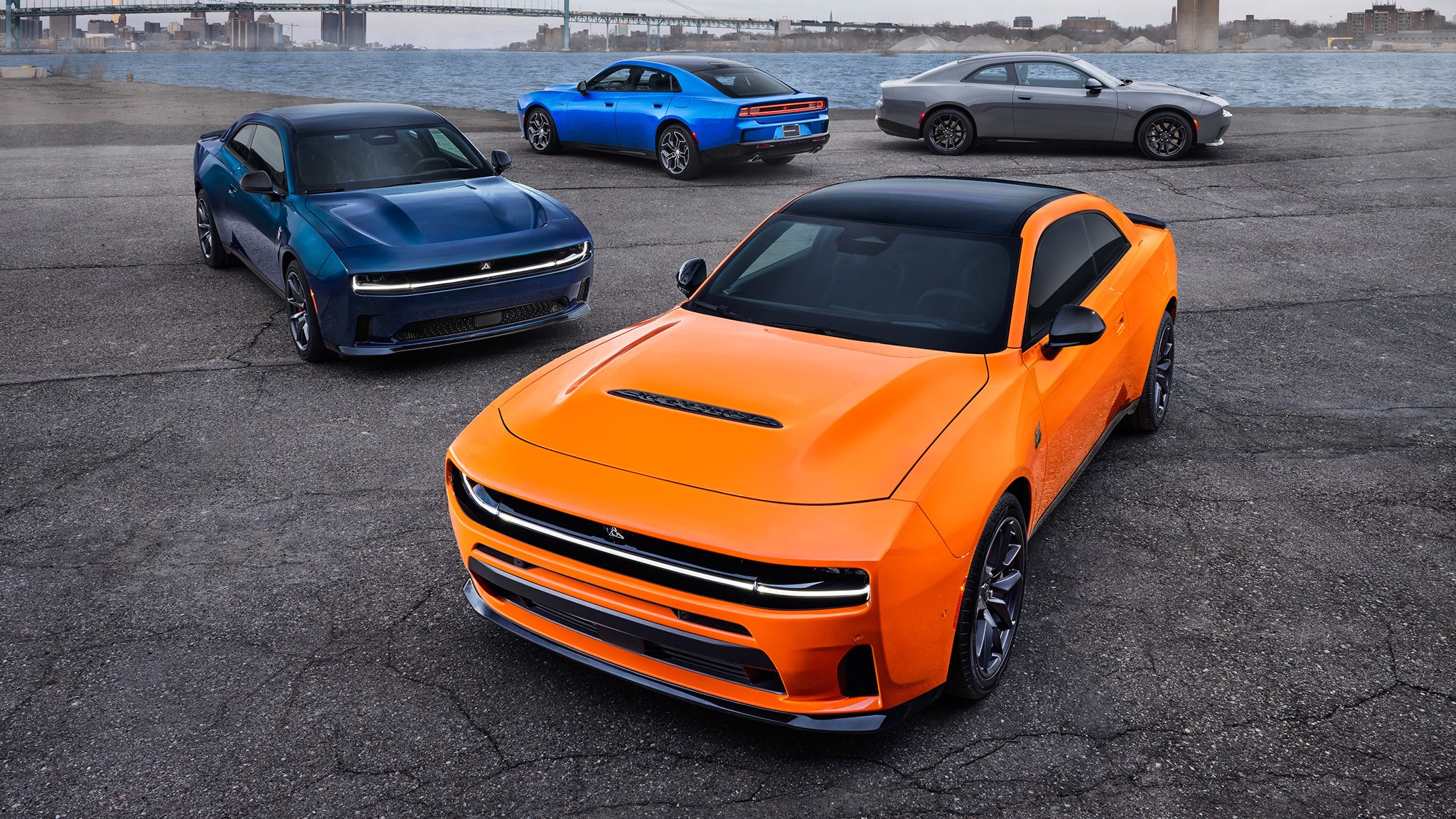
Visually, the gas and EV Chargers are nearly identical beyond the tailpipe location and slightly different front end details. From inside, they’re virtually identical. The Sixpack measures 206.6 inches long, 79.8 inches wide, and 59.2 inches tall—longer and wider than a Toyota Sienna minivan. The wheelbase stretches 121 inches. It’s a genuinely large car that drives smaller than its dimensions suggest, which is a genuine achievement.
The fact that Dodge engineered this much size and weight to feel planted during cornering speaks to serious chassis engineering. Yes, it feels like a big sport sedan rather than a traditional muscle car. Yes, that’s exactly what Dodge intended. That’s not compromise; that’s evolved thinking about what a modern performance platform should deliver.
Final Thoughts: Redemption Through Competence
The 2026 Dodge Charger Scat Pack Sixpack represents something increasingly rare in automotive manufacturing: conscious choice followed by excellent execution. Dodge could have made a worse gas engine. They could have bolted something quick but soulless under the hood. They could have ignored the all-wheel-drive requirements and delivered an uncontrollable monster. They could have given up on the platform compromise and just built a muscle car.
Instead, they built something thoughtful. Something that works. Something that, yes, costs $56,990, but delivers genuine performance, sophisticated engineering, and the kind of character that separates honest machines from cynical cash-grabs.
Is it perfect? No. The steering is numb, the infotainment is frustrating, the line lock is a comedy of errors, and the exhaust underwhelms. But these are relatively minor frustrations in a package that fundamentally accomplishes what it set out to do.
If you’ve been waiting for a new gas-powered Charger and don’t need to hold out hope for a V-8 resurrection, here’s your car. It’s ready, it’s capable, and—surprisingly—it’s genuinely good.