Mazda Vision X-Coupe and X-Compact: Rotary Power Returns with 510-HP Plug-In Hybrid
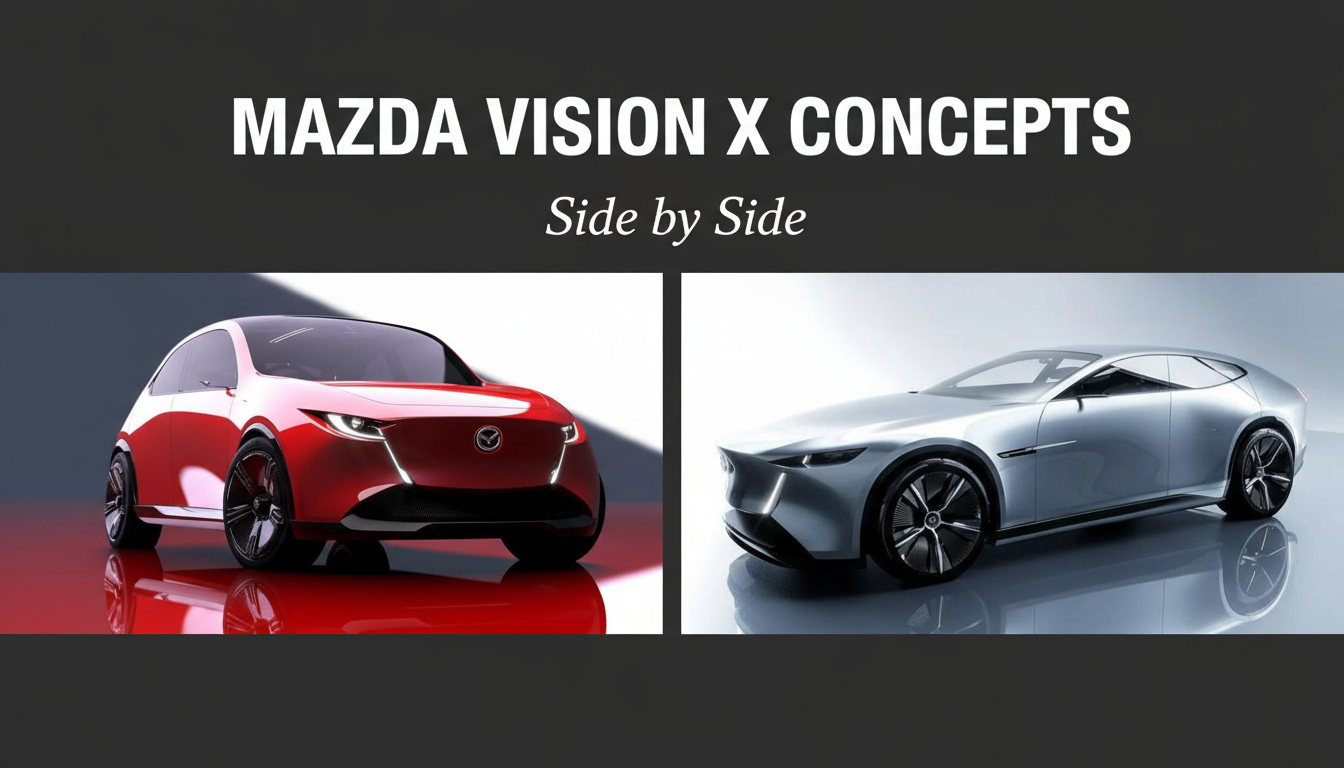
Mazda just unleashed two concept cars at the Japan Mobility Show 2025 that showcase radically different visions for the brand’s future. The Vision X-Coupe brings back the rotary engine in plug-in hybrid form with 510 horsepower, while the Vision X-Compact explores AI-powered emotional connectivity between driver and vehicle. Both concepts embody Mazda’s exhibition theme: “The Joy of Driving Fuels a Sustainable Tomorrow.”
The real headline? Mazda hasn’t abandoned the rotary engine—they’ve reimagined it for the electrified era, pairing it with motors and batteries to create a performance hybrid system that supposedly reduces atmospheric CO2 the more you drive it.
Vision X-Coupe: Rotary Resurrection with Eco Credentials
The Vision X-Coupe is a four-door sports coupe powered by a two-rotor turbocharged rotary engine integrated with electric motors and battery pack. Mazda claims 510 PS (503 horsepower), though they’ve withheld torque figures, acceleration times, and specific powertrain details.
The plug-in hybrid system offers two operating modes: electric-only driving provides 160 km (roughly 100 miles) of range, while combined engine-motor operation extends total range to 800 km (approximately 500 miles). That combined range rivals traditional combustion vehicles while maintaining pure-electric capability for daily commuting.
Here’s where Mazda’s environmental claims get interesting—they say the Vision X-Coupe can reduce atmospheric CO2 the more it’s driven. This involves two technologies: carbon-neutral fuel derived from microalgae, and “Mazda Mobile Carbon Capture,” their proprietary CO2 capture system.
Whether this actually results in net-negative emissions depends on lifecycle analysis that Mazda hasn’t provided. Growing microalgae absorbs CO2, converting it into biomass that becomes fuel. Burning that fuel releases the captured CO2 back into the atmosphere—theoretically carbon-neutral if the cycle is closed. The mobile capture technology presumably removes additional CO2 from the air while driving, though exactly how remains unexplained.
These claims warrant skepticism until independently verified, but they represent Mazda’s attempt to position rotary technology as environmentally responsible rather than merely nostalgic.
Mazda Vision X-Coupe (5)
Mazda Vision X-Coupe (4)
Mazda Vision X-Coupe (3)
Mazda Vision X-Coupe (2)
Mazda Vision X-Coupe (1)
mazda_vision_x-coupe_jms25_2_highres
MAZDA VISION X-COUPE_INT_03
mazda_vision_x-coupe_jms25_1_highres
mazda_vision_x-coupe_jms25_3_highres
mazda_vision_x-coupe_jms25_4_highres
mazda_vision_x-coupe_jms25_5_highres
MAZDA VISION X-COUPE_EXT_02
MAZDA VISION X-COUPE_EXT_01
MAZDA VISION X-COUPE_EXT_04
MAZDA VISION X-COUPE_INT_01
MAZDA VISION X-COUPE_EXT_03
MAZDA VISION X-COUPE_EXT_05
MAZDA VISION X-COUPE_EXT_09
MAZDA VISION X-COUPE_EXT_06
MAZDA VISION X-COUPE_EXT_08
MAZDA VISION X-COUPE_EXT_07
Design: Evolved Kodo Philosophy
The Vision X-Coupe measures 5,050mm long, 1,995mm wide, and 1,480mm tall on a 3,080mm wheelbase. For reference, that’s slightly longer and taller than an Aston Martin Vanquish but narrower. It’s a substantial four-door coupe emphasizing presence and grand touring proportions.
Mazda describes the styling as further evolution of their Kodo-Soul of Motion design language that’s defined their vehicles since the early 2010s. The concept features flowing surfaces, sculpted character lines, and dramatic proportions that prioritize elegance over aggressive angularity.
Whether this design language translates to production or remains pure concept fantasy depends on whether Mazda actually builds something resembling the Vision X-Coupe. Their track record includes stunning concepts like the RX-Vision that never reached production, alongside concepts like the Vision Coupe that influenced the Mazda3’s design.
Vision X-Compact: AI Companion on Wheels
The second concept takes a completely different approach. The Vision X-Compact is a compact vehicle (3,825mm long, significantly smaller than the X-Coupe) designed around what Mazda calls “the fusion of a human sensory digital model and empathetic AI.”
Mazda positions this as a vehicle that acts like a “close companion,” engaging in natural conversation, suggesting destinations, and forming emotional connections with drivers. It represents their vision for smart mobility where vehicles understand driver preferences, moods, and needs.
This concept feels less developed than the X-Coupe—Mazda provided no powertrain details, interior images, or specifics about the AI system’s capabilities. It reads more like directional thinking about future mobility rather than a near-production preview.
The cynical read: automotive AI companions sound great in press releases but risk being annoying in reality. Voice assistants in current cars often frustrate more than help. Whether Mazda can actually deliver AI that feels genuinely empathetic rather than programmed responses remains highly questionable.
Vision X-Compact
Vision X-Compact (2)
Vision X-Compact
Vision X-Compact
Vision X-Compact
Vision X-Compact
Vision X-Compact
Vision X-Compact
Vision X-Compact
Vision X-Compact
Vision X-Compact
Vision X-Compact
The All-New CX-5: Actual Production Reality
Alongside the concepts, Mazda displayed the all-new CX-5 (European specification) to the public for the first time. This represents actual product—a redesigned version of Mazda’s bestselling SUV that’s moved over 4.5 million units globally.
The new CX-5 features Mazda’s E/E Architecture+, their updated electrical and electronic architecture enabling advanced driver assistance systems and connectivity. It promises refined Kodo design, enhanced Jimba-ittai (oneness between driver and car) driving dynamics, and improved interior space.
This is what Mazda will actually sell while the concepts generate headlines. The CX-5 funds Mazda’s business while rotary concepts feed enthusiast dreams.
The Rotary Question: Will It Happen?
Mazda has teased rotary revival repeatedly. The RX-Vision concept from 2015 promised rotary sports car return—it never materialized. The MX-30 R-EV uses a rotary engine purely as a range extender generating electricity, not driving wheels directly.
The Vision X-Coupe’s plug-in hybrid approach makes more business sense than pure rotary sports car. It addresses rotary engine’s traditional weaknesses (poor fuel economy, high emissions) by pairing it with electric motors. The rotary runs in optimal efficiency ranges while motors handle low-speed driving and boost performance.
But concepts and production are vastly different. Engineering a production-viable two-rotor turbocharged plug-in hybrid system requires enormous investment. Mazda’s relatively small size compared to Toyota, Volkswagen, or GM makes such investments difficult to justify for low-volume performance vehicles.
Masahiro Moro’s statement about remaining “committed to fulfilling the desire of those who love cars and wish to continue driving” sounds encouraging. But corporate commitment and financial reality often conflict.
What This Actually Signals
These concepts represent Mazda’s positioning: we’re not abandoning driving enthusiasts even as the industry electrifies. The rotary hybrid approach attempts squaring the circle—delivering performance and engagement while meeting emissions regulations.
The AI companion concept acknowledges that many future vehicles will prioritize connectivity and autonomous capability over driving dynamics. Mazda wants to explore that space without abandoning their “driver-focused” brand identity.
Whether either concept reaches production in recognizable form is uncertain. But they serve important functions: generating media coverage, gauging public reaction, demonstrating engineering capability, and reassuring enthusiasts that Mazda still cares about driver engagement.
The cynical view: they’re pure marketing theater with minimal production intent. The optimistic view: they’re genuine explorations of how Mazda can maintain brand identity through industry transformation. Reality probably sits somewhere between.