Singer DLS Turbo “Sorcerer”: The First 700-HP Track Weapon
Singer Vehicle Design occupies a unique space in the automotive pantheon—universally admired for its obsessive craftsmanship, quietly polarizing for its approach to air-cooled 911s. The California restomod specialist doesn’t restore cars; it reimagines them as modern supercars while preserving the 1989-1993 964 donor’s soul. The debut of the DLS Turbo “Sorcerer”—the first production example of Singer’s Porsche 934/5-inspired program—proves why the brand commands $3 million+ price tags even as it sparks endless donor-car debates.
The Polarizing Masterpiece Emerges
Singer announced the DLS Turbo program in 2023, channeling the savage 934/5 silhouette that terrorized 1970s endurance racing. Where previous DLS models celebrated road purity, this variant splits into road and track specs. “Sorcerer” arrives as the first track specification build, transforming a meticulously vetted 964 donor into a carbon-clad time machine with contemporary savagery.
Every Singer begins the same way: complete teardown, ultrasonic cleaning of every component, structural reinforcement, then reassembly around modern mechanicals wearing period-correct skin. “Sorcerer” emerges as a 934/5 homage that’s equal parts museum piece and circuit assassin—beautiful enough for concours, brutal enough for the ‘Ring.
Singer DLS Turbo Sorcerer
Exterior: Fantasia Blue Fade, 934/5 Silhouette
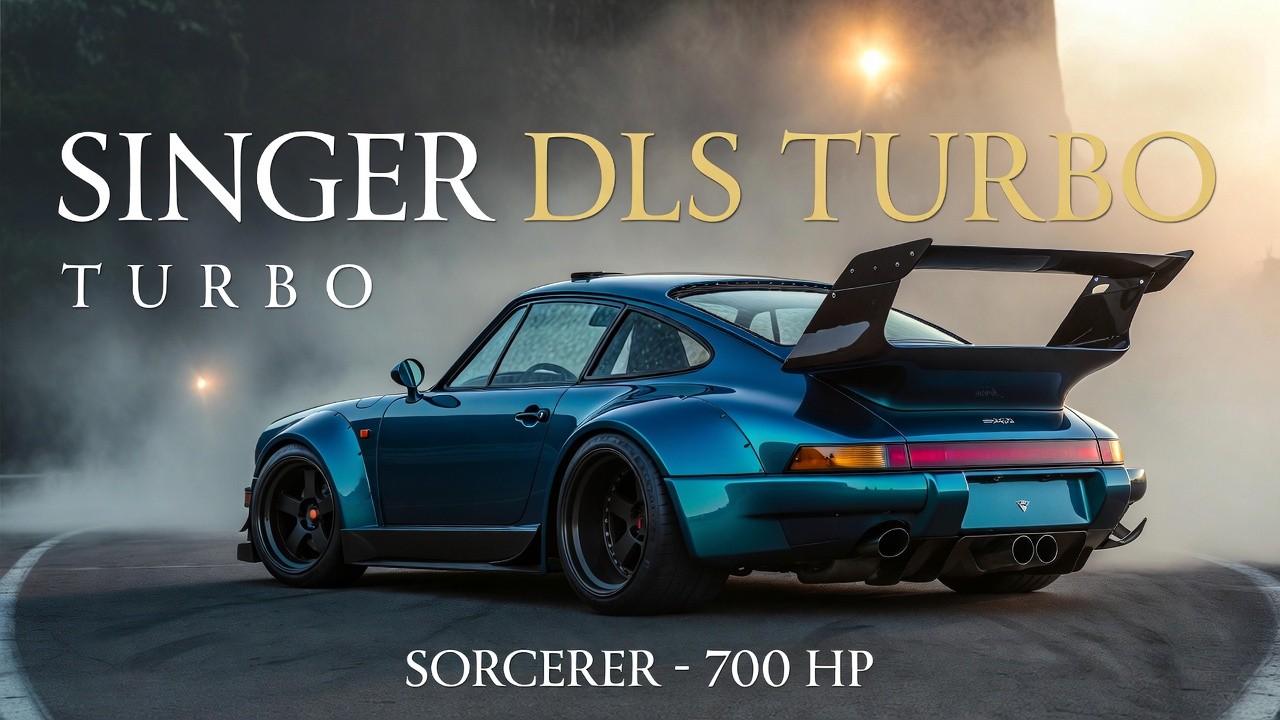
The bodywork grabs you first. Singer’s sculpted carbon-fiber panels channel the 934/5’s flared arches, deep front air dam, and massive rear wing, but refined for modern aerodynamics. “Sorcerer” wears a graduated Fantasia Blue paint—starting bright at the nose, bleeding progressively darker toward the tail. The effect makes the car appear to shift hues with every angle, light condition, and velocity.
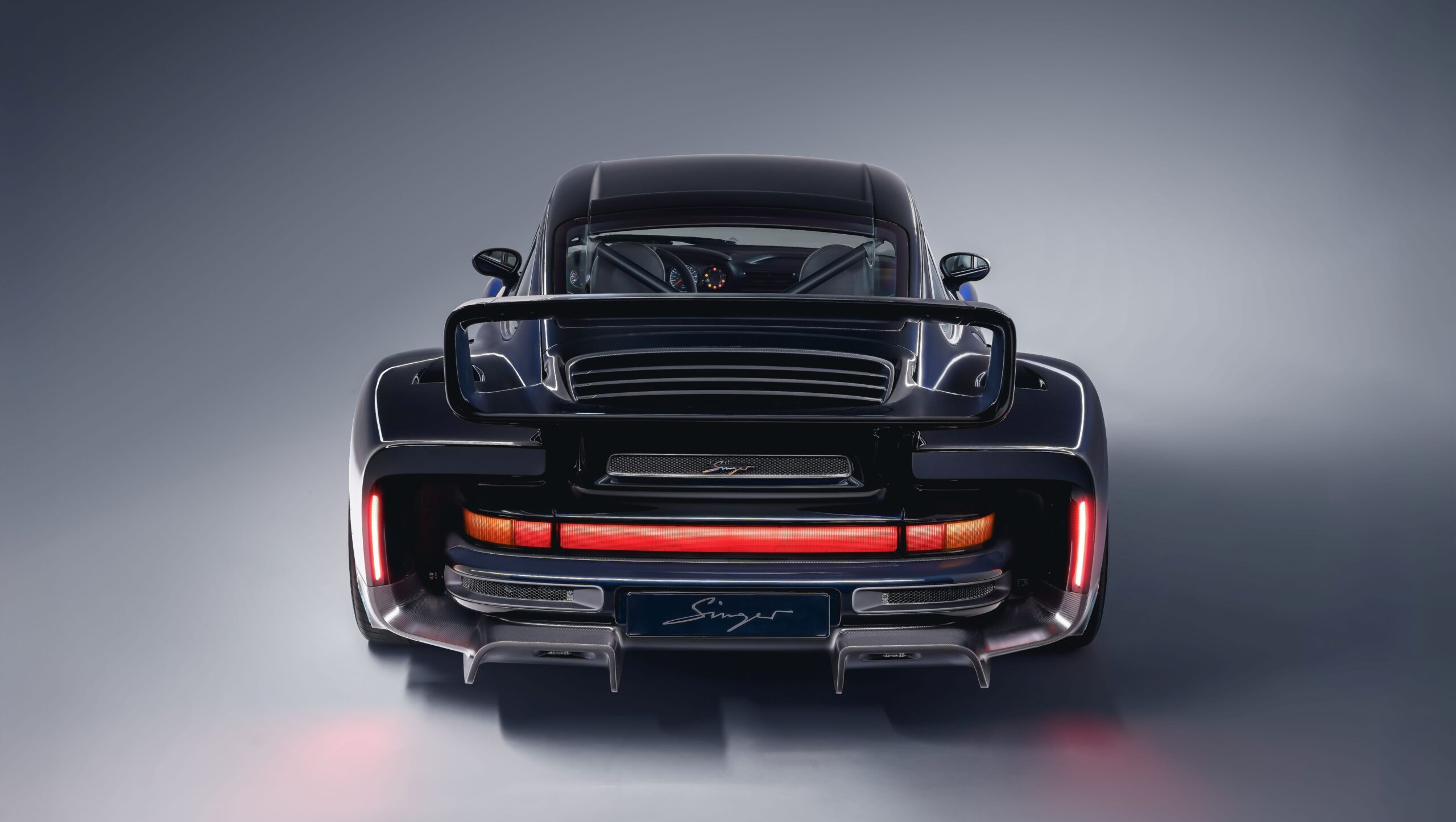
Up front, an enlarged carbon lip splitter feeds massive intakes while managing airflow to the twin-turbo flat-six. Side vents cool massive brakes and extract hot air from the wheel wells. The rear features a gargantuan carbon wing arching from the bumper, paired with functional diffusers and quad exhaust outlets framing the license plate recess. Every aero element serves double duty—downforce generation meets visual drama.
Gold-caliber details include exposed carbon hood vents, mirror caps blending body color with satin finish, and 18-inch Singer alloys wearing sticky Michelin Pilot Sport Cup 2R rubber. At 4500 pounds, “Sorcerer” plants itself like a 911 GT2 RS wearing Le Mans bodywork.
Singer DLS Turbo Sorcerer
Singer DLS Turbo Sorcerer
Mechanical Heart: 9000-RPM Twin-Turbo Flat-Six
Singer’s engineering lives beneath the skin. The 3.8-liter twin-turbo flat-six blends air-cooled cylinders with water-cooled heads and electronic wastegates for precise boost control. Peak output: 700 horsepower and 553 lb-ft at 9000 rpm—Porsche 930 territory with GT2 reliability.
Power flows through a six-speed manual with raised gated shifter (linkage visible from the cockpit) to the rear wheels exclusively. No PDK here—this is analog savagery. The Inconel/titanium hybrid exhaust exits both sides of the car, positioned for optimal sound and heat management. Titanium mufflers and active valves mean silent neighborhood exits transform into Le Mans wails above 4000 rpm.
Chassis upgrades match the engine: adjustable KW Competition coilovers, 346-mm carbon-ceramic front brakes with six-piston calipers, 380-mm rears with four-pistons, and wider rear track (+1.5 inches) for planted cornering. The result should deliver GT3-level grip with 934/5 presence.
Singer DLS Turbo Sorcerer
Interior: Pebble Grey Artistry
Inside, “Sorcerer” reveals Singer’s obsessive personalization. The owner specified Pebble Grey leather upholstery paired with Pearl Grey Alcantara seats and Champagne contrast stitching. The transmission tunnel shines in satin carbon fiber, with Champagne accents highlighting switchgear, seatbelts, and gauge bezels.
Four-point harnesses meet Recaro Pro-XL seats. Custom gauges blend analog Porsche charm with digital clarity. Leather wraps the dash, console, and doors; Alcantara carpets the floors. A single Porsche Classic radio with Bluetooth anchors the dash—no iPad screens here. Every surface begs touch; every stitch telegraphs quality control that borders on madness.
Singer DLS Turbo Sorcerer
The Controversy: Finite Donors, Infinite Ambition
Singer occupies restomod’s most uncomfortable truth: each build consumes a sound 964 that could otherwise appreciate untouched. At $3-4 million delivered, “Sorcerer” represents collector money parked in garages rather than concours fields. Purists argue the supply matters more than any single execution.
Yet Singer mitigates this through obsessive donor vetting—rust-free, low-mileage Californians rebuilt to exceed factory spec—and unmatched craftsmanship. Each flat-six receives 200+ hours of dyno development; each panel clears Singer’s exacting aesthetic standards. The result transcends “modified Porsche”—it’s a new category vehicle wearing familiar skin.
Why “Sorcerer” Matters
Ultimately, Singer builds for owners who understand the 911’s eternal appeal: mechanical purity meets modern capability. “Sorcerer” exists for the collector who wants 934/5 silhouette with GT3 lap times, or the racer seeking air-cooled soundtrack with carbon-ceramic stopping power. It drives the point home Singer’s mission: perfect the past without apology.
The hope remains simple: whoever holds “Sorcerer’s” keys actually exercises its 9000-rpm scream on track days and canyon roads. That’s what separates great engineering from museum pieces—living, breathing proof that Singer’s alchemy genuinely elevates the world’s most capable donor car into tomorrow’s legend.